
Safe Waters in Health & Social Care: How TMVs Help Prevent Scalding and Protect Vulnerable People
Safe Waters in Health & Social Care: How TMVs Help Prevent Scalding and Protect Vulnerable People
In health and social care facilities, maintaining high water temperatures is essential for various reasons, such as meeting hot water demand, efficient boiler operation, and controlling the risk of harmful bacteria, such as Legionella. However, when the water temperature used for bathing or showering exceeds 44°C, the risk of serious injuries or fatalities significantly increases. This is particularly crucial for vulnerable individuals who may be exposed to scalding during whole-body immersion.
Identifying High-Risk Groups
Health and social care providers often cater to individuals susceptible to scalding or burns, including children, older people, and those with reduced mental capacity, mobility, or temperature sensitivity. Additionally, individuals who may not react promptly to prevent injuries are at high risk.
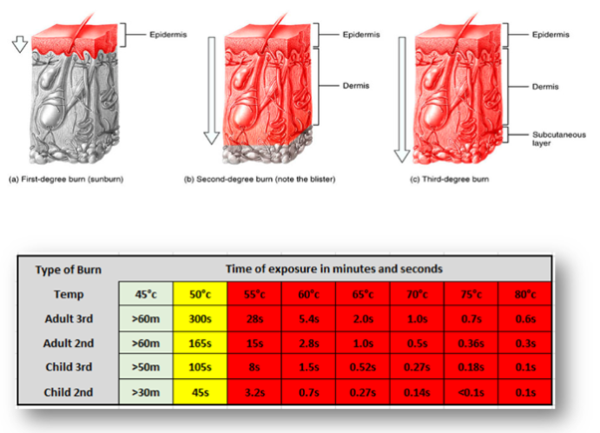
The following pictures show the level of the hot water burn and how quickly hot water can burn children and adults:
Risk Management Strategies
To mitigate the risk of scalding, engineering controls are essential to prevent water hotter than 44°C from being discharged from outlets accessible to vulnerable individuals. Such controls may be necessary at outlets where people are especially vulnerable, such as basins used by individuals with skin sensitivity impairment.
Engineering Controls
Effective engineering controls include the installation of thermostatic mixing valves (TMVs) and temperature-restricted, instant water heaters. TMVs, specifically Type 3 certified as mandated by the Department of Health’s Health Technical Memorandum 04-01, should be placed as close as possible to outlets requiring temperature regulation. Regular safety testing and adherence to healthcare standards ensure these controls remain effective over time.
Alternative Measures
In instances where TMVs are not fitted to baths or showers, equally effective controls must be implemented. However, caution is advised against locking bathroom doors or removing hot tap heads if they hinder regular water flushing, as this may exacerbate the risk of harmful bacteria growth. Such measures should only serve as short-term solutions until thermostatic controls are in place.
Electric Showers
For facilities equipped with electric showers, it is crucial to design them to prevent water from reaching scalding temperatures. While domestic electric showers may have temperature regulation features, fluctuations in flow or pressure could still pose risks. In such cases, additional measures may be required, such as installing ‘healthcare standard’ showers designed to prevent unsafe hot water temperatures under all conditions. Compliance with NHS standards mandates the use of such showers in healthcare settings.
Why TMVs Are a Critical Control Measure
This is where Thermostatic Mixing Valves (TMVs) play a vital role.
A TMV blends hot and cold water so that mixed water reaches a pre-set, safe temperature at outlets like showers, basins, and baths, ensuring users are protected from dangerously hot water. Compared with static tempering or manual mixing, TMVs automatically adjust to pressure and temperature fluctuations, providing consistent safety without compromising hygiene.
In health and social care settings, TMVs are recognised as an essential engineering control and are recommended to prevent water hotter than safe levels from being discharged at vulnerable points of use.
Industry Standards and Best Practice
Standards such as the NHS’s Health Technical Memorandum (HTM 04-01) — widely used in UK healthcare — specifically recommend the use of TMVs to manage hot water safety and discharge temperatures. This guidance supports the correct design, installation, commissioning, and maintenance of safe hot and cold water systems, including the placement of TMVs as close as possible to outlets where temperature regulation is needed.
Where TMVs are not fitted, facilities must deploy other effective controls, but these are generally considered temporary or supplementary. Permanent TMV installation aligned with appropriate testing and maintenance remains the recommended long-term protection strategy.
Protecting Patients, Residents and Staff
By regulating outlet water temperature through TMVs, healthcare providers can:
- Reduce scalding risk for vulnerable users
- Comply with safety and health regulations
- Maintain hot water at temperatures needed for hygiene and bacterial control
- Demonstrate proactive risk management in water safety plans
TMVs are not just plumbing components — they are a key safeguard in building water safety management, particularly where vulnerable people are present.